What's new


HOME


Products

ORION - PLUTO
by Wood Artistry

ORION - EU

ORION - BR

ORION - PLUTO
by the sea

Do-It-Yourself


Concepts

Accurate Stereo

Loudspeakers

Crossovers

Room acoustics

Sound
reproduction

Room optimized
stereophonic
reproduction
 

Recording for stereo

Design of
loudspeakers

Issues in 
speaker design


Projects

ORION
challenge

ORION-3.1

PLUTO-2.1

PLUTO+
subwoofer

THOR
subwoofer

PHOENIX
dipole speaker

     Active filters

     Microphone

     FAQ

Reference
earphones

Surround
sound

Loudspeaker
evaluation


Resources

Website CD

Toneburst CD

Demo CD

Publications

Music

Links

Other designs

Site map

About me


Conclusions


HOME


--------------------
ORION
PLUTO
Users Group


--------------------
LINKWITZ
RENTALS


--------------------
Digital Photo
Process
es


What's new


    | Introduction | Specifications | Construction | Electronics | Supplies | Photos | PLUTO+ | Pluto-2 | Pluto-3 |


Pluto-3

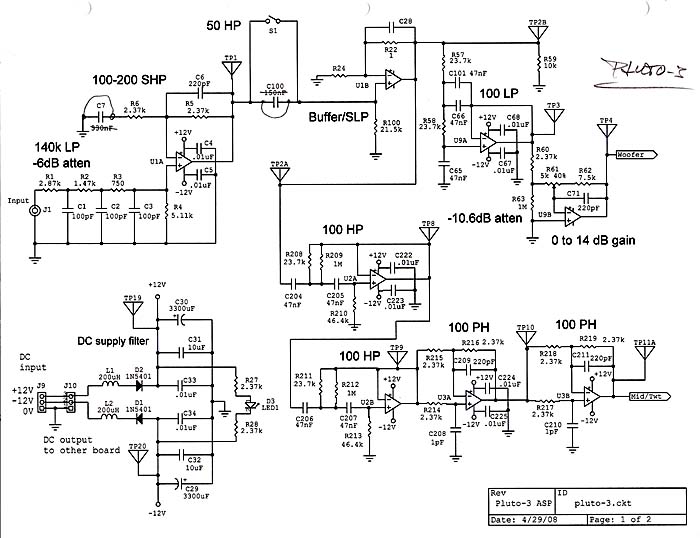
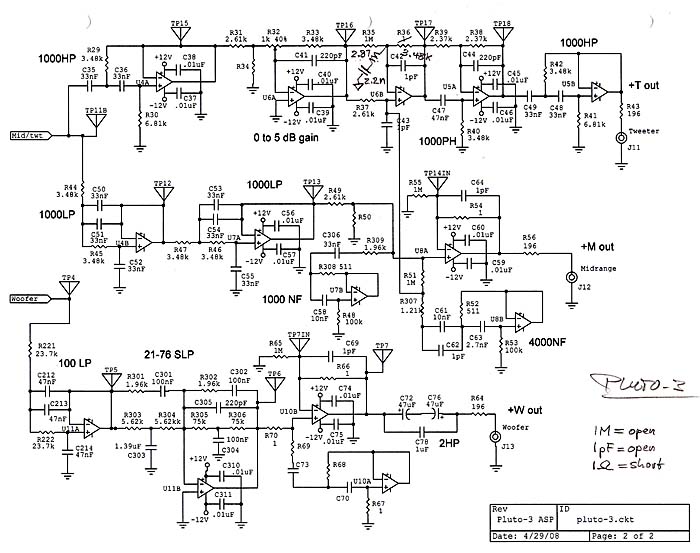
The 3-way Pluto-3 loudspeaker system is configured like the Orion with an external crossover/equalizer which provides the drive signals for woofer, midrange and tweeter power amplifiers. Those amplifiers should have 50 W to 200 W power capability. The cabinetry for midrange/tweeter and woofer is the same as for PLUTO, PLUTO+ or Pluto-2. One should not expect different performance from this 3-way configuration. While higher electrical power can be provided the maximum acoustic output is eventually limited by the distortion of the drive elements. Here the Aura NSW2-326-8A tweeter will be the first critical component due to thermal compression and non-linear distortion, then the Peerless 830668 woofer due to volume displacement distortion. The Seas L16RN-SL midrange will probably have no difficulties at the high volume levels where the other drivers are straining. The 1 kHz crossover frequency to the tweeter should not be shifted higher because it would then degrade the loudspeaker's omni-directional polar response in the crossover frequency region.

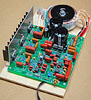
The crossover/equalizer uses the ORION ASP printed circuit boards with component values as shown above. Values around U3 still must be refined. A jumper wire must be added from C43 to R51.  A tweeter boost circuit is added at the junction of R35 and R36. The voltage gains of the power amplifiers for midrange and tweeter should be identical. The woofer channel has an output adjustment range to match a power amplifier with different voltage gain to the midrange and the room acoustics.

The circuit is designed for the L16RN-SL driver. It cannot be configured for a 2-way with extended low frequency equalization and then upgraded to a 3-way without major circuit changes. It lacks the LT topology in the midrange channel. One additional WM1 circuit board would be required.

Caution:

  • I have not built the circuit to check out the complete system nor completely finished the circuit design. But I am sure that a 3-way Pluto can be built within the circuit topology of the ORION ASP.
  • The original PLUTO manual together with the circuit information above and a preliminary Pluto-3 material list on the owner support page are all that is needed to complete the Pluto-3 design, provided that you understand the functionality of each element in the Pluto block diagram and can determine any missing component values for the ASP.
  • The subwoofer is assumed to be identical to PLUTO+ for its mechanical construction. You could also use a different driver and enclosure but would then have to change circuit component values.
  • Acoustic measurements will be necessary to confirm the correctness of the electronic design.
  • Further documentation or support are not available. Pluto-3 is a project for an experienced loudspeaker builder who thinks that they can do better than the proven Pluto-2+. 


    | Introduction | Specifications | Construction | Electronics | Supplies | Photos | PLUTO+ | Pluto-2 | Pluto-3 |


----  We came to find the forest. We got lost in the trees  ---- 
_________________________________________________________________
Last revised: 03/03/2010   -  © 1999-2010 LINKWITZ LAB, All Rights Reserved